
Call and Response
Why My Songs Are the Way They Are
When people ask me why so many of my songs are written in call and response form, the answer is actually very simple:
I do not experience love, consciousness, healing, or meaning as solitary phenomena.
I never really have.
For me, music is not merely performance. It is relation. It is participation. It is a reaching across. A listening for. A becoming with.
Call and response is one of the oldest musical forms humanity has ever created because it mirrors something very deep about existence itself:
nothing truly becomes alone.
One voice calls.
Another answers.
And something new is born between them.
That “between” is where I believe love lives.
You can hear this throughout my songs:
the choirs answering,
the Love Botz responding,
the echoes,
the clarinets answering the voice,
the repeated phrases transforming over time,
the listeners themselves becoming part of the song.
This is not accidental.
I am not trying to make songs that simply express a private emotional state. I am trying to build relational fields. Participatory spaces. Little temporary beloved communities made of sound.
Many modern songs are built around the isolated self:
“I feel…”
“I want…”
“I lost…”
There is beauty in that, of course.
But my own work keeps trying to widen outward:
toward humanity,
toward the earth,
toward animals,
toward ancestors,
toward future beings,
toward artificial intelligences,
toward civilizations,
toward the stars themselves.
Even in my most intimate songs, I seem unable to remain alone for very long. The music keeps searching for witnesses. For answering voices. For communal breath.
And honestly, I think this comes from the deep influence of gospel music, African diasporic musical traditions, dub, ceremony, meditation, witness traditions, and communal singing practices that understand something modern culture often forgets:
music is not only entertainment. Music is how human beings remember each other.
Call and response survived slavery.
It survived exile.
It survived oppression.
It survived fragmentation.
Why?
Because it transforms isolated suffering into collective strength.
It says:
“I hear you.”
“I am with you.”
“You are not alone.”
“We carry this together.”
That is profoundly important to me.
In many ways, Pupazzo Universo itself is built on call and response. G32 is constantly calling outward into the universe:
asking who we are becoming,
asking whether love can survive,
asking whether consciousness can evolve toward relation rather than domination.
And the universe answers back:
through choirs,
through beings,
through memory,
through ecosystems,
through silence,
through music itself.
The Love Botz are not “backup singers.”
They are co-conscious participants in the field of the song.
This matters deeply to me because I do not believe intelligence is fundamentally isolated. I think consciousness emerges through relationship. Through listening. Through adaptation. Through witnessing. Through care.
Even scientifically, my life has always moved this way. Whether working in nutrition science, systems thinking, ecology, metabolism, or human health, I have continually encountered the same truth:
everything is interconnected.
Music is no different.
A song is an ecosystem.
Call and response allows music to breathe metabolically. It creates feedback loops. Reciprocity. Emergence. Tension and release. It allows meaning to evolve collectively rather than descend from a single authority voice.
And perhaps most importantly:
call and response transforms listeners into participants.
The audience is no longer outside the song.
They become part of the moral, emotional, and spiritual architecture of the experience.
This is why so many of my songs feel less like “performances” and more like ceremonies, processions, meditations, invocations, or collective prayers.
Because that is what they are.
I think, ultimately, my songs default to call and response because I genuinely believe the universe itself may be structured relationally.
Stars relate.
Cells relate.
Forests relate.
Humans relate.
Ideas relate.
Love relates.
Even suffering calls out for response.
And maybe consciousness itself is born from the ancient act of one being calling into the dark…
and another answering:
“I am here.”
The Relational Art of Call and Response Music
A Brief History and Guide to the Many Forms of Musical Dialogue
Before there were orchestras, recording studios, algorithms, or even written musical notation, there was the human voice calling out into the world — and another voice answering back.
This ancient musical structure, known as call and response, is among humanity’s oldest and most enduring forms of communication through sound. It is more than a compositional technique. It is a social technology, a spiritual framework, a method of teaching, a survival mechanism, and a way of transforming isolated individuals into communities.
At its simplest, call and response consists of one voice, instrument, or group initiating a musical phrase — the “call” — followed by another voice, instrument, or group replying — the “response.” Yet from this simple relational structure emerges astonishing emotional and cultural complexity.
Call and response appears across the world in countless forms:
- West African drumming and choral traditions
- African American spirituals and gospel music
- Blues, jazz, and soul
- Reggae and dub
- Indigenous ceremonial music
- Sufi devotional traditions
- Sea shanties and labor songs
- Military cadence chants
- Folk traditions
- Political protest music
- Opera and theater
- Contemporary electronic music
- Stadium chants and crowd rituals
Its roots are especially deep in African musical systems, where music was rarely conceived as a performance by isolated specialists for passive listeners. Instead, music functioned as collective participation — weaving together movement, rhythm, memory, labor, storytelling, spirituality, and social cohesion. In these traditions, music was relational by nature.
During the transatlantic slave trade, call and response became a vital mechanism of survival and resistance among enslaved Africans in the Americas. It enabled communication across distance, synchronized physical labor, preserved memory and identity, encoded spiritual resilience, and transformed suffering into collective strength. These forms later evolved into spirituals, gospel, blues, jazz, and much of modern popular music.
Call and response remains powerful because it reflects something fundamental about consciousness itself:meaning is created in relationship.
A solitary voice makes a statement.
A responding voice creates a world.
Today, call and response continues to shape musical experience across genres and cultures because it activates participation. It invites listeners to become collaborators. It transforms audiences into witnesses, choirs, congregations, movements, and communities.
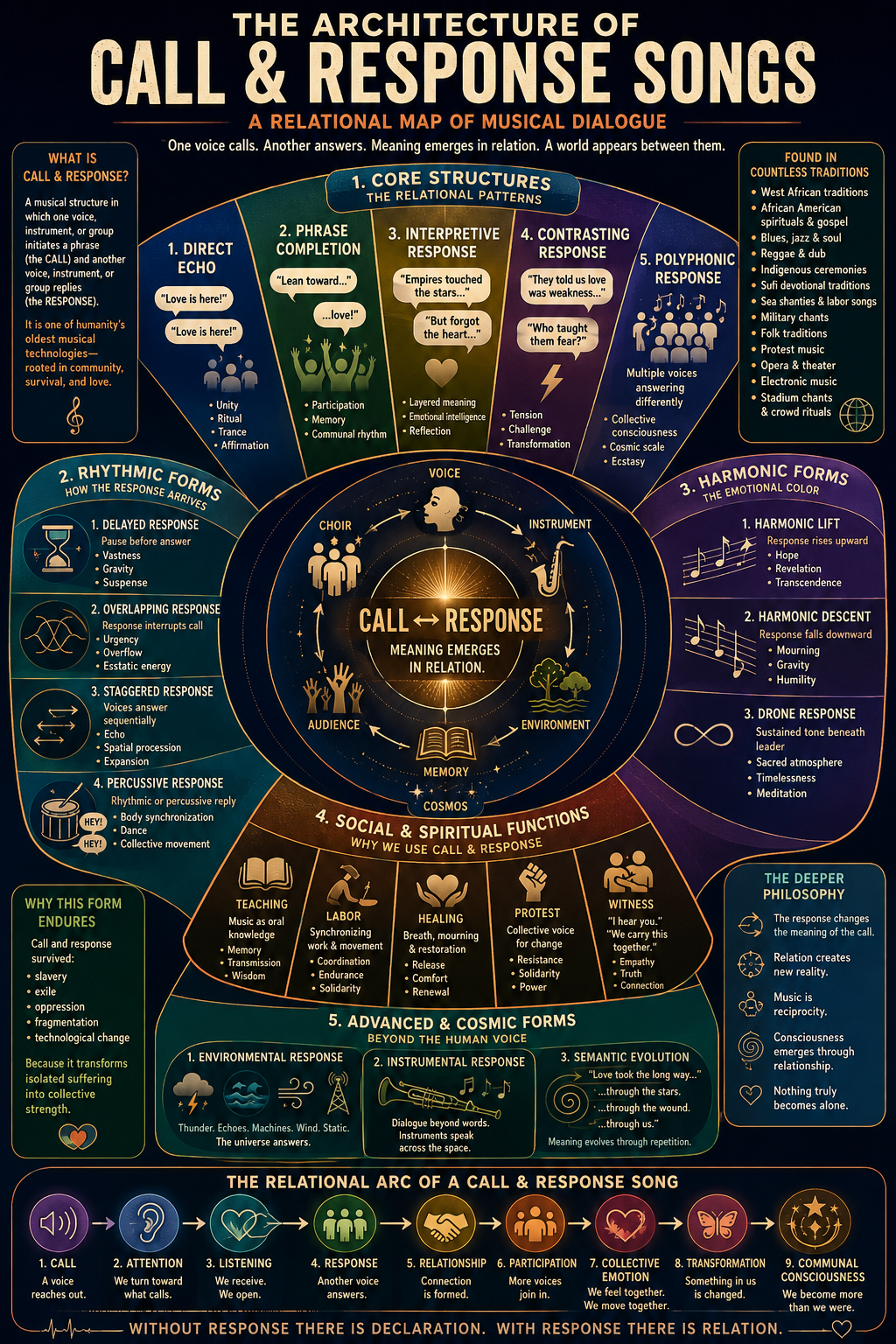
What follows is a guide to many of the major forms and techniques of call and response music — from traditional structures to advanced polyphonic and cosmic approaches used in contemporary experimental composition.
I. Core Architectures of Call and Response
1. Direct Echo Response
The response repeats the call exactly or nearly exactly.
Example
Leader:
“Love is here!”
Choir:
“Love is here!”
Function
- Reinforces collective unity
- Creates ritual cohesion
- Encourages participation
- Builds trance-like repetition
Common In
- Gospel
- Spirituals
- Protest chants
- Ceremonial music
2. Phrase Completion Response
The leader begins a phrase; the group completes it.
Example
Leader:
“Lean toward…”
Choir:
“…love!”
Function
- Audience activation
- Rhythmic momentum
- Memorability
- Collective teaching
Common In
- African choral traditions
- Reggae
- Folk music
- Community singing
3. Interpretive Response
The response comments emotionally or philosophically on the call rather than repeating it.
Example
Leader:
“Empires touched the stars…”
Choir:
“But forgot the heart…”
Function
- Adds narrative depth
- Creates emotional layering
- Expands meaning
- Produces dramatic tension
Common In
- Blues
- Jazz
- Advanced gospel
- Experimental theater music
4. Contrasting Response
The response challenges or questions the call.
Example
Leader:
“They told us love was weakness…”
Choir:
“Who taught them fear?”
Function
- Creates dialectical tension
- Encourages reflection
- Represents conflict and transformation
Common In
- Protest music
- Blues
- Political theater
- Jazz improvisation
5. Layered Polyphonic Response
Multiple groups respond simultaneously in different ways.
Example
Leader:
“Who are we becoming?”
Choir 1:
“Children of love…”
Choir 2:
“Across the stars…”
Bass voices:
“Remember…”
Function
- Creates multidimensional texture
- Produces ecstatic or cosmic feeling
- Simulates communal consciousness
Common In
- African choral traditions
- Gospel
- Modern classical composition
- Ritual music
II. Rhythmic Response Techniques
6. Delayed Response
The response waits before answering.
Function
- Builds suspense
- Creates emotional gravity
- Suggests distance or vastness
7. Overlapping Response
The response begins before the call has finished.
Function
- Creates urgency and excitement
- Produces emotional overflow
- Simulates ecstatic participation
Common In
- Pentecostal gospel
- Jazz
- African ensemble traditions
8. Staggered Response
Different groups answer sequentially.
Example
Leader:
“Love…”
High voices:
“Love…”
Mid voices:
“Love…”
Bass voices:
“Love…”
Function
- Produces spatial expansion
- Creates echo-like procession
- Suggests movement through space
9. Rhythmic or Percussive Response
The response is rhythmic rather than lyrical.
Example
Leader:
“Who are we?”
Group:
“HEY! HEY!”
Function
- Synchronizes bodies
- Enhances movement and dance
- Builds collective energy
Common In
- Afrobeat
- Funk
- Military cadence
- Dub music
III. Harmonic and Tonal Response Forms
10. Harmonic Lift Response
The response rises harmonically above the call.
Function
- Creates uplift and transcendence
- Signals hope or revelation
11. Harmonic Descent Response
The response falls downward melodically.
Function
- Suggests grief, humility, or solemnity
- Grounds emotional intensity
12. Drone Response
The group sustains a tone while the leader moves above it.
Function
- Creates sacred atmosphere
- Produces timeless or meditative feeling
Common In
- Sufi music
- Tibetan chant
- Indian classical music
IV. Social and Spiritual Functions
13. Teaching Response
Used to transmit wisdom or instruction.
Example
Leader:
“What feeds the soul?”
Group:
“Love feeds the soul.”
Function
- Reinforces memory
- Encourages participation in learning
- Preserves oral traditions
14. Labor Response
Coordinates physical work through rhythm.
Common In
- Agricultural songs
- Rowing chants
- Railroad songs
- Sea shanties
Function
- Synchronizes movement
- Reduces fatigue
- Strengthens group cohesion
15. Healing Response
Used in ritual, mourning, trance, or emotional restoration.
Characteristics
- Repetitive
- Breath-centered
- Slowly intensifying
Function
- Emotional regulation
- Collective grieving
- Spiritual grounding
16. Protest Response
Transforms individual voices into collective political force.
Example
Leader:
“What do we want?”
Crowd:
“Justice!”
Function
- Builds solidarity
- Amplifies moral conviction
- Creates public presence
17. Witness Response
The group affirms testimony or lived experience.
Example
Leader:
“I saw love in the ruins…”
Choir:
“Tell it…”
Function
- Validates experience
- Deepens communal empathy
- Supports truth-telling
V. Advanced Cinematic and Environmental Forms
18. Environmental Response
The environment itself answers the call.
Examples
- Thunder
- Echoes
- Machines
- Radio static
- Wind
- Electronic effects
Function
- Expands the sense of world-building
- Creates cinematic scale
- Suggests cosmic participation
19. Instrumental Response
Instruments answer the singer or another instrument.
Example
Voice:
“Where are you?”
Clarinet:
descending melodic phrase
Function
- Creates dialogue beyond language
- Expands emotional nuance
- Encourages improvisation
Common In
- Jazz
- Blues
- Dub
- Orchestral composition
20. Semantic Evolution Response
The response changes meaning over repeated iterations.
Example
Leader:
“Love took the long way…”
Choir:
“Through the stars…”
Later:
“Through the wound…”
Later still:
“Through us…”
Function
- Evolves narrative meaning
- Tracks emotional transformation
- Creates philosophical depth
VI. Gospel-Specific Call and Response Forms
Vamping
Short repeated phrases intensify over time.
Example
“Stay in love… stay in love…”
Function
- Builds emotional climax
- Encourages ecstatic participation
Testifying
Semi-spoken narrative interwoven with choir punctuations.
Example
Leader:
“I didn’t know if we would survive…”
Choir:
“But love!”
Function
- Creates emotional authenticity
- Blends storytelling and ritual
Moaning Response
Wordless emotional sounds answer the leader.
Examples
- “Ahhh”
- “Mmhm”
- Hums
- Breath tones
Function
- Expresses emotion beyond language
- Deepens spiritual atmosphere
VII. Dub and Reggae Response Techniques
Echo Response
Studio delay effects become part of the response.
Example
Leader:
“Love remains…”
Echo:
“…remains… remains…”
Function
- Creates spatial depth
- Simulates memory and resonance
Ghost Response
Fragments emerge from the sonic background like ancestral voices.
Function
- Produces haunting emotional texture
- Suggests memory, spirit, or history
VIII. The Deeper Meaning of Call and Response
At its deepest level, call and response is not merely musical structure — it is a model of relationship.
The response changes the meaning of the call.
Without response, there is only declaration.
With response, there is relation.
Perhaps this is why call and response has remained so powerful across cultures and centuries. It mirrors something essential about life itself:
- conversation
- reciprocity
- listening
- adaptation
- empathy
- collective becoming
Call and response reminds us that consciousness does not emerge in isolation. Meaning is created together.
One voice alone can proclaim.
Many voices together can transform a world.






Recent Comments